
A Proposal: A Strategic Mandate for Canada's Financial Crimes Agency
The opinion piece below was written by Dr. Jessica Davis and published in January 2026 in the Globe and Mail:
Jessica Davis is the president of Insight Threat Intelligence and the author of Illicit Money: Financing Terrorism in the Twenty-First Century. She was consulted by the government of Canada on the development of a new financial crimes agency.
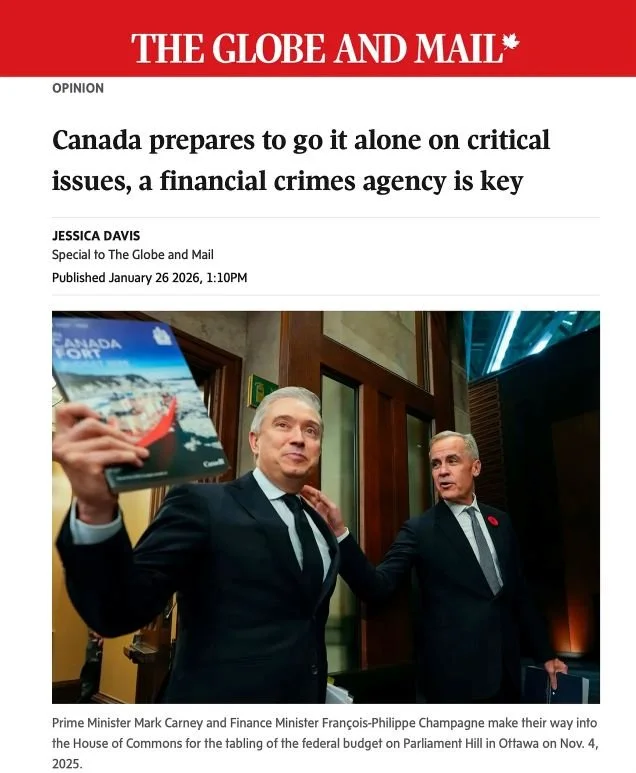
In Budget 2025, the Carney government promised to create a Canadian Financial Crimes Agency, introducing legislation by the spring of 2026, to address a growing range of financial threats facing Canadians.
This is not the first time Canadians have heard this promise: a financial crimes agency was promised in the Liberal election platform of 2021 and has been in various stages of policy development since that time. Yet Canadians have heard very little about the promised agency, except for Finance Minister François-Philippe Champagne’s promise in the fall of 2025 that it would tackle sophisticated financial crimes.
As Canadians face unprecedented levels of sophisticated fraud, ransomware attacks, and geopolitical uncertainty, it’s time for the government to set an ambitious and clear mandate to protect Canadians and our financial sector.
Canada is slowly coming to terms with the fact that its once most-valued partner is increasingly unreliable. This is true in the world of trade as much as it is true in the world of security and intelligence.
The United States has long been an important law-enforcement partner, conducting joint investigations with Canadian police and often taking the lead on terrorist financing or money-laundering investigations. Today, and for the foreseeable future, Canada must prepare to go it alone on critical issues, as the U.S. has recently proven that it can only be relied upon to serve its own immediate and mercurial interests.
In this context of geopolitical uncertainty, Canada must protect the financial sector and Canadians against a smorgasbord of threats. Top of mind for most Canadians is fraud: many know someone who has been directly targeted by sophisticated fraud. These frauds are often perpetrated from abroad, sometimes by people who themselves are victims of human trafficking networks. Money from these schemes is moved swiftly offshore, and often through cryptocurrency. Another threat, ransomware, targets critical infrastructure and services, holding mission-critical data hostage until a ransom is paid. When payments are made to restore services, those payments embolden and strengthen criminals.
While fraud and ransomware are well-known threats to Canadians, the threat from those seeking to avoid sanctions is quietly stalking our financial system. Historically, enforcement of Canadian sanctions has been spotty at best. In the cryptocurrency era, sanctions evasion through Canada has been supercharged. According to one report, the Canadian cryptocurrency sector ranks in the top 10 worldwide in terms of exposure to sanctioned entities. This places Canada on the same list as countries such as North Korea, Russia, and Iran. Canada needs to take immediate action, or we risk becoming a haven for sanctions evasion.
Finally, Canada also needs to address the growing issue of professional money laundering networks. These networks of professionals (accountants, lawyers, and business owners) exist to launder the proceeds of a variety of crimes, including drug trafficking and fentanyl production. These professionals create separation between the main crime and the ultimate beneficiary of the money, making it harder to hold criminals accountable. Addressing this issue requires specialized, skilled, and dedicated financial crime professionals.
The financial sector is a bright beacon in Canada’s economy. Canada must get smart, innovative, and efficient at combating financial crimes targeting and exploiting the sector.

Our Terrorist Financing Analysis course caters to researchers, intelligence, law enforcement, and compliance professionals, helping them learn about terrorist financing and analyze suspicious patterns to disrupt terrorist activities more effectively. Sign up today to grow your counter-terrorism expertise.
The future Canadian Financial Crimes Agency will face tremendous challenges from the threat environment and from structural issues in this country. In addition to the threats outlined above, the agency will have to spend considerable resources to avoid conflict with other departments, the RCMP, and other police forces. It will also need to engage in horizontal co-ordination across the 13 federal departments and agencies responsible for Canada’s anti-money laundering regime, as well as with provinces and territories.
While avoiding conflict and ensuring co-ordination will be important, the future agency will also need serious teeth. It will need considerable powers to collect intelligence and evidence, analyze that information, investigate crimes, and, ideally, to compel, prohibit, sanction, and disclose information as required. The agency will also require a clear reporting and review structure, with actionable objectives and performance metrics.
A new agency will be expensive, but it will also be a tremendous opportunity for Canada to develop its considerable existing financial investigative capabilities into a world-class agency to fight serious and transnational financial crimes and protect our important financial sector and Canadians.
A future Financial Crimes Agency needs a focused mandate to address the most pressing threats and robust authorities to carry out this mission.
© 2026 Insight Threat Intelligence Ltd. All Rights Reserved.
This article and its contents are protected by Canadian copyright law. Except as otherwise provided for under Canadian copyright law, this article and its contents may not be copied, published, distributed, downloaded or otherwise stored in a retrieval system, transmitted or converted, in any form or by any means, electronic or otherwise, without the prior written permission of the copyright owner.