
Is left-wing terrorism on the rise in the US?
In this article we will be discussing current (as of September 2025) terrorism threat levels in Canada and the US.
My friend and colleague Dan Byman and his coauthor Riley McCabe produced an Atlantic article and an accompanying CSIS report on left-wing terrorism in the United States. It generated a significant uproar, as I’m sure many can imagine. (I had to limit my interactions on Bluesky as a result. Don’t let anyone ever tell you that only X has an echo chamber or political ideology problem.)
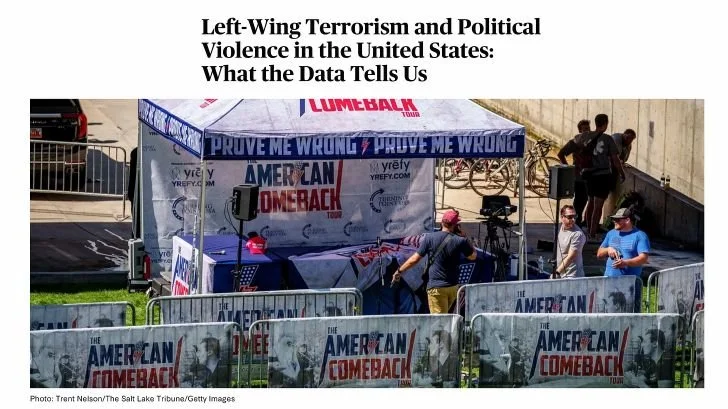
Now, the first thing I want to note is the headlines about this article. I don’t know if the authors wrote the Atlantic headline, but it’s a bit misleading. It says “left wing terrorism is on the rise”. Is it? The Washington Post does a fair bit better with the headline “Left-wing actors responsible for more attacks this year…”. This, from what I’ve seen of the data, the second headline is more accurate.
Those not steeped in data might wonder what point I’m making, so let me explain.
The authors collect data from January 1, 1994, to July 1, 2025 and categorize attacks and plots as left and right wing, as well as jihadist and ethnonationalist. This is standard practice: We all make categorization and coding decisions to enable our analysis. The authors are transparent with how they do this, and also note that some attacks defied categorization. (Also normal). You can definitely disagree with coding decisions. In fact, it’s encouraged! Reproducibility is an essential part of the scientific process, so having someone else review your data, recode it, and rerun the analysis can yield truly interesting results. Do they get something similar? Your data, theory, and explanations are robust. Do they get something different? Also interesting and requires investigation!
The authors collected 750 terrorist incidents during this time frame. This is a pretty robust sample. (Remember: terrorism tends to be a small data problem, unlike general crime.) Their data appears to show an increase in left-wing terrorism attacks and plots over this time (Figure 1). I say ‘appears’ because there are no tests for statistical significance noted in the analysis. When I recreated the data and ran tests for statistical significance at 5 and 10-year intervals, there was none. (This means left-wing terrorism is actually stable over time, not increasing.) I didn’t include the first half of 2025 in my analysis because I don’t have data intervals for half years.
Does that mean that the author’s data and conclusions are wrong? Not quite. I just think they’re premature. 2025 might well be a turning point in the data, but it’s too soon to say. (Hence why the second headline is better written than the first.)
I would also say that the authors’ discussion of terrorist incidents, motivation, and the changing political landscape is really good. The only thing I would change is how they characterize the change (or rather, the lack of change) in the number of left-wing attacks, and add tests for statistical significance.

Our Illicit Finance investigations bundle includes access to both Financial Intelligence Fundamentals and Financial Intelligence Sources and is your one-stop shop to learn how to conduct an illicit finance investigation.
Enroll Today!
How does this compare to Canada?
Canada and the US tend to have terrorism trends that reflect each other (or rather, Canada tends to lag the US’s overall trend). In Canada, you can see a significant spike in ideologically motivated terrorist attacks in 2017, illustrated in the graph below. Interestingly, this is equal parts attacks from right-wing and left-wing terrorism. (I had to re-code my data to match the authors' definitions, because IMVE terrorism in Canada is both right and left.)
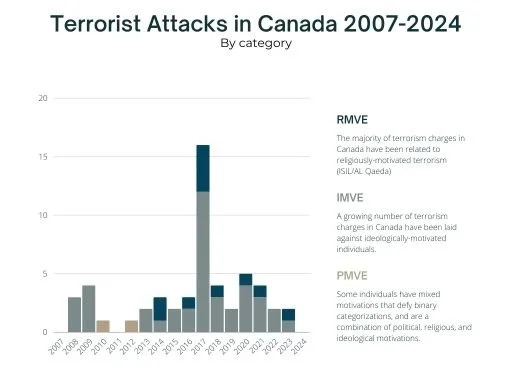
Since 2017, however, there have only been two left-wing terrorist attacks in Canada.1 All the other IMVE attacks have been right-wing.
So, to compare these data with the US, I’d say that Canada has seen a sharp drop-off in left-wing terrorism, while the US’s experience has been steadier. However, like the US, Canada has seen a significant rise in right-wing terrorism. The question is: will this trend persist?
Again, it’s worth reflecting on the authors’ discussion to understand the challenges facing both countries and anticipate what we might expect from terrorism in this country.
“…widespread polarization and misperceptions that the other side is far more violent than it actually is creates a dangerous environment where extremists can more easily rationalize using violence. Growth in even a tiny minority who are willing to commit partisan violence has the potential for tremendous consequences considering the combustible political climate in the United States and the fact that symbolic and strategically important political leaders are among the potential targets.”
We should read this as a warning. Polarization and mis and disinformation fan the flames of extremism, and can increase the pool of people who are willing to commit violence for their beliefs — regardless of their ideology or political affiliation. I would also add that violence tends to beget violence, so when one group becomes more violent, it can also spark a backlash from other groups.
© 2025 Insight Threat Intelligence Ltd. All Rights Reserved.
This article and its contents are protected by Canadian copyright law. Except as otherwise provided for under Canadian copyright law, this article and its contents may not be copied, published, distributed, downloaded or otherwise stored in a retrieval system, transmitted or converted, in any form or by any means, electronic or otherwise, without the prior written permission of the copyright owner.