Illicit Political Finance in Alberta’s Separatist Movement?
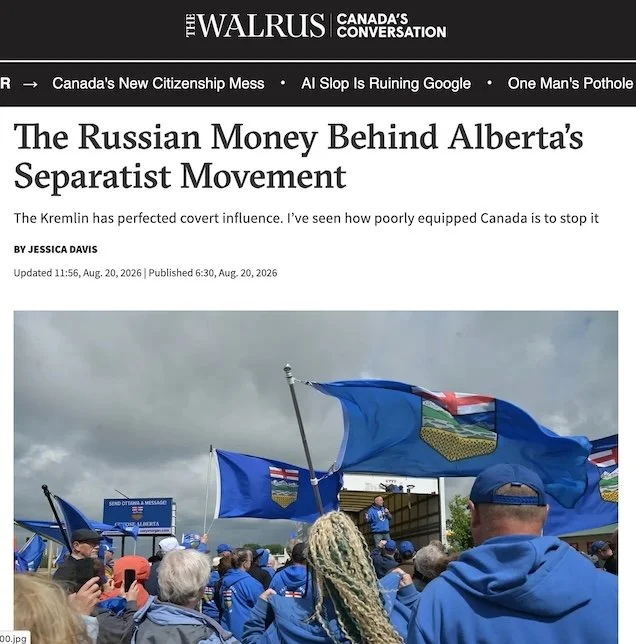
The Walrus published an article in August 2026, that I had been working on for a couple of months. Today I’m sharing a bit of the background and impetus behind the article.
I’ve been mulling the issue of foreign interference in Alberta’s upcoming referendum for some time. I’ve been reading everything Patrick Lennoxhas been writing on this issue — which is particularly useful given his background, but also as a current Albertan. I’ve also been doing a lot of work this year internationally on what I’ve come to call illicit political finance, including a very informative trip to Moldova. Of course, all of this builds on work I did for the Foreign Interference Commission. I define illicit political finance as follows:
Illicit political finance is the funding or support in political processes that are illegal, undisclosed, disguised, excessive, prohibited, or otherwise structured to avoid detection, attribution, transparency, or accountability. It encompasses a wide range of practices that distort the financial conditions of political competition.
Beyond clearly unlawful conduct (breaching political finance laws, for instance), illicit political finance can also involve practices that formally comply with existing rules but are designed to circumvent their intent, such as fragmenting donations, using intermediaries, or exploiting regulatory gaps.
Illicit political finance has also been described as state threats, foreign interference financing, malign influence, and political money laundering. It involves a variety of actors, levels of government, and methods. These include foreign states, non-state actors, criminal organizations, political opponents, and individuals and corporations.
These actors seek to influence the political process for economic, political, financial, and regulatory benefits. They target the general public (seeking broad influence), diaspora communities, individual voters, riding associations, political parties, and influential individuals. Illicit political funding might also seek to influence the media and information ecosystem through disinformation or propaganda campaigns targeting voters, or through targeted ads, sponsored opinion pieces, paying influencers, and deploying bot networks. Resources might be used to amplify specific narratives or political messages, or to suppress messages.
When it comes to Alberta and a potential referendum, my concern is this: Alberta has a number of referendum actors (political parties, third-party advertisers, educational initiatives, and interested individuals) all seeking to influence the outcome. However, many of these actors are not subject to current political finance rules. At the same time, several countries, most notably the US and Russia, also have an interest in the outcome of a potential referendum.
In this piece for the Walrus, I articulate these concerns, what can be done about it, and what Canada (and other countries) should be doing to defend against illicit political finance. Because, as I’ve seen firsthand in Moldova, many foreign actors want to influence democratic processes, outcomes, and the information space, and most democratic countries are ill-equipped to handle it.
This bundle includes the Terrorist Financing Analysis course, the Terrorist Financing Analytic Tool, the Case Studies Library, and the Hamas and January 6th Financing Reports! It also includes a one-year subscription to the Insight Monitor newsletter. Enroll today!
© 2026 Insight Threat Intelligence Ltd. All Rights Reserved.
This article and its contents are protected by Canadian copyright law. Except as otherwise provided for under Canadian copyright law, this article and its contents may not be copied, published, distributed, downloaded or otherwise stored in a retrieval system, transmitted or converted, in any form or by any means, electronic or otherwise, without the prior written permission of the copyright owner.