

Canada Gets a Third* Terrorism Financing Conviction
Khalilullah Yousuf’s guilty plea in May 2025 marks another terrorism financing conviction in Canada and offers a window into the evolving mechanics of terrorist financing. The case involved a blend of traditional and modern tactics - from cash transfers and charitable causes to cryptocurrency and encrypted messaging - all within a transnational network. As Canada prepares for its FATF evaluation later in 2025, this conviction also reflects the country’s growing capacity to prosecute financial facilitators of terrorism.

Security and Intelligence Priorities for the Carney Government
What should national security in Canada look like under the Carney government? This commentary outlines four key priorities: RCMP reform, deeper intelligence partnerships beyond the U.S., better use of intelligence for economic security, and a stronger sanctions regime targeting criminal and cyber actors.

Digital Dark Money: A Critical Review of Terrorist Financing via Cryptocurrency
Despite rising concerns about crypto, most terrorist groups still move money the old-fashioned way. This book review explores how traditional methods like bank, hawalas, and high-value goods dominated terrorist financing from 2010 - 2020, and why emerging technologies remained secondary during that period. It’s a timely look at how evidence-based research can help narrow the gap between assumption and operational reality.

Trade Wars and Dirty Money
Trade wars reshape global markets, but they also open the door to financial crime. As tariffs shift supply chains and businesses look for workarounds, illicit actors exploit the chaos—moving money through shell companies, skirting sanctions, and fueling underground economies. This piece breaks down how economic conflict drives dirty money and what that means for financial and national security.
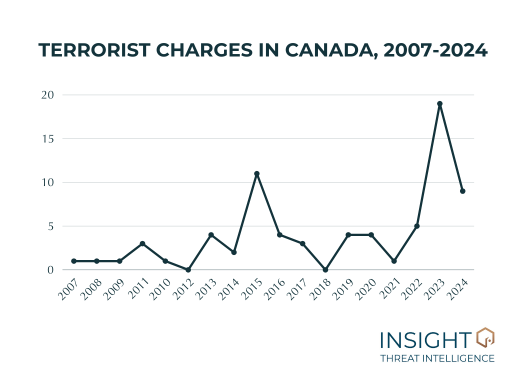
Terror on the Rise: What the Increase in Terrorism Charges in Canada Can Tell us About the Threat
Terrorism Charges in Canada are on the rise, raising questions about the evolving threat landscape. This article examines trends in terrorist arrests and prosecutions from 2007 to 2024, highlighting shifts in motivation, types of attacks, and the broader implications for counterterrorism efforts within the country.

Hamas Financing 2024: Key Insights and Analysis
We’re winding things down here at ITI for the year, so we thought we’d share a few of our major themes from the year, one of which is Hamas financing. While we did a lot of work on the group’s financing back in 2023 (including a series looking at how the group raises, uses, moves, stores, manages, and obscures their funds) and counter-terrorist financing options, 2023 was focused on debunking some myths and updating that analysis after a year of Israeli counter-terrorism operations.

Insight Monitor Dispatches: extremist financing through cryptocurrencies and a terrorist listing
We have a few updates for you this week that you might find interesting on extremist financing under a Trump presidency, the listing by Canada of the Houthis as a terrorist entity, and Canada’s upcoming FATF evaluation.

Canada’s $44 Billion Dirty Money Crisis
Canada’s underground economy moves an estimated $44 billion in dirty money each year, fueling organized crime, real estate speculation, and financial corruption. With loopholes in enforcement and regulatory blind spots, illicit funds continue to flow through casinos, shell companies, and real estate. As authorities scramble to crack down, the question remains—how deep does this problem go?

Funding the Flames: The Dark Side of Crowdfunding and Terrorism
From illicit trade to crowdfunding, terrorist groups find creative ways to fund their operations. This review breaks down the financial networks that keep them running, the loopholes they exploit, and the challenges in cutting off their cash flow.

ITAC: Canada's Integrated Terrorism Assessment Centre
Canada’s Integrated Terrorism Assessment Centre (ITAC) plays a crucial role in identifying and assessing terrorist threats. This piece explores how ITAC operates, its role in counterterrorism efforts, and the challenges it faces in an evolving threat landscape.

Foreign Interference Financing
Foreign influence isn’t just about diplomacy or espionage—it’s about money. Covert funding flows through hidden channels to sway elections, shape policies, and undermine institutions. This piece unpacks how foreign actors use financial networks to exert control and why it’s so hard to stop.

Podcast: Hamas financing after October 7th
Since the October 7 attacks, Hamas’s financial networks have been under pressure. This episode looks at how the group raises and moves money, the effect of sanctions, and whether global efforts to cut off funding are making an impact.
Risk and Reward: How Shadow Economies Impact the Financial Practices of Militant Organizations
Shadow economies operate beneath the surface, shaping global finance in ways most people never see. From illicit trade to underground banking, these hidden markets fuel both risk and opportunity. This piece explores how they function, who profits, and why authorities struggle to crack down.

Foreign Interference in Canada: Naming names?
Foreign interference in Canada isn’t just speculation—it involves real people, real networks, and real consequences. This piece lays out who’s involved, how they operate, and what Canada is doing about it.

The Financial Future of the Islamic State
The Islamic State’s financial future is evolving as governments crack down on its traditional revenue streams. From illicit trade to online fundraising, this piece explores how the group is adapting, where its money comes from now, and what that means for global security.

Taylor Swift and the Economics of Terrorism
A terrorist plot forced Austrian authorities to cancel Taylor Swift’s Vienna concerts, dealing a financial blow to the city despite the attack being prevented. The economic fallout highlights how terrorism disrupts local economies—even when no attack takes place. This piece looks at the financial impact of the cancellations, how much was lost, and what it means for counterterrorism policy
The Compliance Industrial Complex and Its Grip on Modern Governance
The compliance industrial complex has reshaped financial regulation, but who really benefits? This book review explores how compliance-driven governance influences surveillance, corporate power, and financial control—and why some of its core assumptions may not hold up to scrutiny.

Covert Currency: State and Non-State Actors in Espionage Financing
Spies don’t work for free. From state-funded salaries to secret cash drop-offs and cryptocurrency transfers, espionage financing is an overlooked but essential part of intelligence operations. This piece breaks down how spies get paid, who funds them, and what financial red flags can reveal about covert activity.

Mapping Canada's White Power Ecosystem
White power movements in Canada have a long history, from neo-Nazi groups in the 1930s to modern extremist networks. This ten-part series maps out where these groups operate, their tactics, and how they finance their activities. The first article in the series takes a closer look at the Diagolon network, its reach, and its influence. Over the next ten weeks, we’ll dive deeper into the white power ecosystem in Canada and its evolving landscape.

Exploiting the Dark Web for Terrorist Financing
Terrorist groups exploit the dark web for secure communication, propaganda, and financial transactions. From cryptocurrency donations to illicit trade, the dark web offers anonymity that makes tracking and disrupting terrorist financing difficult. This piece explores how extremists use hidden online networks to move money and the evolving countermeasures aimed at stopping them.